Pages

Showing posts with label cocktails. Show all posts

Friday, February 13, 2015

Recipe: J'adore Paris

J'adore Paris
Circa: 2015
 

      Tomorrow is a special day to show someone how much they mean to you and what better way to toast to a great love or friendship then with a cocktail! This delicious drink is perfect for Valentine's Day in Paris whether you are in France or Texas!
 
       To complete my Paris inspired week I wanted to add my own special touch to one of my favorite cocktails, the French 75. I was introduced to this cocktail classic on an anniversary trip to New Orleans, Louisiana. Chris and I wandered into Arnaud's French 75 Bar and several of the locals insisted that we have the bar's namesake drink. We'll as they say, when in Rome! It was delicious and has become a staple in our household. While the original is perfect I wanted to add a special touch to it in honor of Valentine's Day. 


For my take on the French 75 I wanted to add a little romance through the use of the Rose Brut Champagne, St. Germaine Elderflower Liqueur and a flower petal garnish. I love using St. Germaine because it adds a beautiful floral sweetness to any cocktail which absolutely perfect for this romantic holiday! While these beautiful flowers are courtesy of my husband and his garden, if you don't have a green thumb (I can sympathize) you can find edible flower petals in many grocery stores today in the produce section.
 
 
I hope that you enjoy this beautiful and simple cocktail inspired by one of my favorites! Also, be sure to visit the blog next week to check out a few more of my favorite places in "I Love Paris" Part Two!
 
 Happy Valentine's Day!
 

Tuesday, October 21, 2014

Recipe: The Voodoo Queen

The Voodoo Queen
Circa: 1700's


         In honor of our witchy theme for our Halloween table I am bringing you not one but two cocktails! As discussed in a previous post I found inspiration for this year' theme from one of my all-time favorite movies, Practical Magic, and my new love, American Horror Story: Coven.  Since I was inspired by two different bewitching shows I thought it only appropriate to craft two different cocktails!   

         
         Today’s cocktail, the Voodoo Queen, is inspired by Coven and the mysterious magic, voodoo and hoodoo found in New Orleans. I think this cocktail would fit in quite well in the Crescent City, but do have to admit that my initial attempts ended with mixed results.  However, with a little magic, I finally found the right concoction of fruit, rum, and sage and the Voodoo Queen was born. What I love about this cocktail is the Sage Simple Syrup. Sage is such a wonderful herb and I love to use it in baking, especially for my brown butter sage cornbread muffins! It just tastes like fall.
            In addition to being delicious, sage also has its own magical properties. For thousands of years sage has been used for blessing, cleansing and purification and is often burned during religious and personal ceremonies. The Greeks and Romans believed hat it imparted wisdom and mental acuity. Others believed that sage brought about immortality, or at the very least a long and healthy life. It is also said to aid in reversing spells and protect against the evil eye. While I can't attest to its magical qualities, I can tell you it makes a declicious cocktail!


          Part of the spirt for the Voodoo Queen comes from the fact that in New Orleans you can’t go too far without coming across a reference to Voodoo. Voodoo is a religion that originated in Africa and Haiti during the French Colonial period and arrived in America a little over 250 years ago. All in all, it is an interesting combination of various African, Catholic and Native American religious traditions.  And as some of you may know, the unchallenged queen of Voodoo is none other than New Orleans’s own Marie Laveau.
Marie was born in and lived in New Orleans in early 19th Century. She was skillful in the practice of medicine and was acquainted with the valuable healing quality of indigenous herbs, which made her quite a successful nurse during frequent yellow fever and cholera epidemics. Her skill and knowledge earned her the friendship of many, although others attributed her success to unnatural means and became fearful. Those that believed in her powers turned to Marie for assistance in their love lives or careers for her gris-gris and magical connections.  Although she is sometimes referred to as mysterious or even dark, her obituary, dated June 18, 1881, shows that “she was a wonderful woman…always had the cause of the people at heart and was with them in all things.” To this day it is believed that you can still request favors from Marie by leaving money, cigars, rum and candy as offerings at her tomb in St. Louis Cemetery No. 1.

          While we may never know whether Marie is to be revered or feared, her work her power and legend will continue to live on in New Orleans for ages to come. With her blend of natural magic and sweetness, I believe that Marie would have approved of our own sweet potion and I hope you enjoy it as well. Cheers!


Wednesday, July 23, 2014

Recipes: Hemingway's Gin and Tonic

Hemingway's Gin & Tonic 
Circa: 1930's


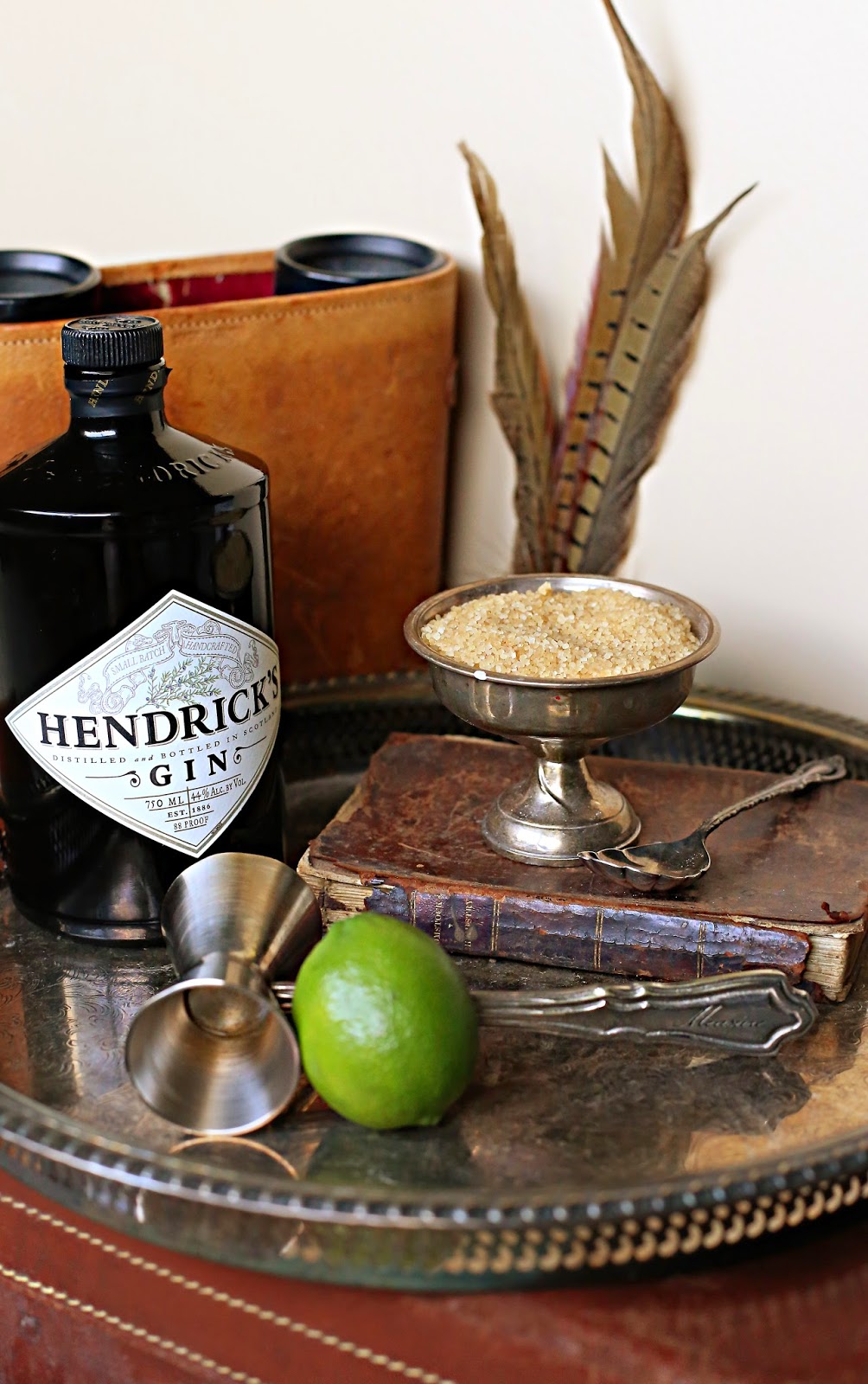
      Today I am sharing with you my go-to drink for the summer! I must give credit to my husband for introducing this delicious drink to me. As many know, Texas this time of year can only be described as HOT! Therefore, the cooler and more refreshing the cocktail, the better. Knowing that my spirit of choice is gin he shared this recipe with me and I have been hooked ever since. Legend states that this was one of famed author Ernest Hemingway's favorite drinks and hangover cures. Hemingway made the drink his own concoction with the addition of Angostura bitters to the classic gin and tonic.  Since I prefer my drinks a little bit sweet,  I added in a little spoonful of Turbinado sugar. Whether you like yours sweeter or not, the drink is still delicious.  Now, as you sip here is your history for the day! 

         The history of tonic water is fascinating!  In 1638 when the wife of the Spanish Viceroy in Peru fell ill with malaria her husband pleaded with the local Incas for an antidote. They instructed her to drink a potion containing the ground bark of the native Quinquina Tree, what we would call the first dose of quinine. Luckily for the countess, the potion worked and she made a full recovery.  Later in 1825 the British military wished to improve the taste of their very bitter, anti-malarial quinine so they decided to combine it with water, sugar, tonic and gin, a very popular British spirit! Rather than taking their medicine with the troops in the morning, the officers began enjoying theirs at cocktail hour.  The classic Gin and Tonic was born! It would become the quintessential drink of the expansive British Empire. 


     Finally, I thought I couldn't leave you without a little information about our own cocktail's namesake, Ernest Hemingway!  He was born on July 21, 1899 in Cicero, Illinois. While he was raised in the suburbs of Chicago, his family's frequent trips to their cabin in northern Michigan fostered the future sportsman's love of hunting, fishing and an appreciation of the outdoors. 

     Hemingway worked as a journalist before serving (and being wounded) in World War I as an ambulance driver in the Italian Army.  His wartime experiences later inspired his famous novel, A Farewell to Arms.  After the war, Hemingway moved to Paris and became a key part of what Gertrude Stein called "The Lost Generation." Some of his acquaintances included F. Scott Fitzgerald, Ezra Pound, Pablo Picasso and James Joyce. In 1925 after a trip to a festival with British and American expatriates Hemingway was inspired to pen one of his greatest works The Sun Also Rises

     In 1928 Hemingway moved back to America and settled in Key West Florida and continued his writing. When he wasn't working Hemingway spent much of his time chasing adventure and big game hunting in Africa, bullfighting in Spain, and deep-sea fishing in Florida. He went back to the battlefield as a war correspondent reporting on the Spanish Civil War in 1937.  His experiences again inspired a classic; this time, For Whom the Bells Tolls.   He later even used his fishing boat to help look for Nazi submarines in the Caribbean during World War II.

     In 1951 Hemingway received a Pulitzer Prize for his book The Old Man and the Sea and a Nobel Prize for his collection of works in 1954. Sadly as he grew older his mind and body began to fail him. He retired permanently to Idaho and early on the morning of July 2, 1961, Ernest Hemingway committed suicide. 

     Though it's a sad end to an incredible man, his legacy of enjoying life  keeps going.  So seize the day and enjoy your own Hemingway Gin & Tonic while enjoying one of Papa Hemingway's classics!


Sources
www.biography.com 
http://qtonic.com

Thursday, July 3, 2014

Recipe: The Redcoat Cocktail

The Redcoat
Circa: 1776


           We are having a few friends over to the house tomorrow to celebrate the 4th of July and I thought that it would be fun to have a signature cocktail for the festivities! July in Houston means very warm days so I wanted to have something very light and refreshing for guests that also took advantage of the beautiful and delicious fruits that are in season! When I was testing out recipes for my 4th of July cocktail a friend commented that I was using traditional British spirits for a uniquely American celebration. I happen to love using Pimms Cup No.1 and Gin for cocktails this time of year and I didn’t even realize that they were right! But since we are serving an All-American menu ending with a very patriotic red, white, and blue dessert I thought why not have British-inspired cocktails and tell the whole story of the American Revolution and our fight for Independence. So that is how the name and concept of this cocktail came to be. I present to you The Redcoat!
             Of course I can’t leave you without a little bit of background information and history that you can read while sipping your cocktail. I thought it would be fun to do a little research and find out more about the Redcoats in honor of our drink! The dictionary defines Redcoat as a British soldier especially in America during the Revolutionary War. The red uniform was officially adopted by the Parliament of England in 1645 when they passed the New Model Army ordinance. The infantry wore coats of Venetian red with white facings. While red uniforms are by no means exclusive to the British Army, their extensive use of this color over a period of nearly 300 years has made it an icon of the British Empire.
             Why red? One of the main reasons for choosing the vibrant color was the fact that russet and crimson dyes were relatively cheap to produce. Roots of the madder plant were dried, crushed and hulled to produce the red colored dye. In addition there was a growing popular sense that red was the national English color. It has also been said that they believed the red would hide blood stains; however this has proven to be a myth.
             While today most people wouldn’t choose bright red for a military uniform because it would make a soldier easy to spot from across the field….well in the 18th century that was the whole point! Surprised?  During a time where a musket had a limited range and accuracy and battlefield visibility was obscured by clouds of smoke the bright red uniform helped commanders and fellow troops distinguish friend from foe!
             In parting I want to wish everyone a very Happy 4th of July filled with friends, fireworks and maybe even a few Redcoats!